IPPF returns to the UN Crime Congress to advance strategies for reducing reoffending
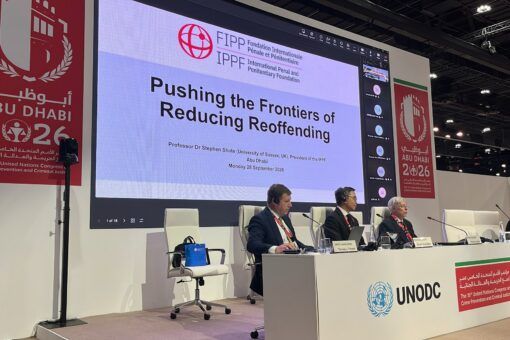
The International Penal and Penitentiary Foundation (IPPF) continued its return to the heart of international criminal justice debate on 28 September 2026, when IPPF President Professor Dr Stephen Shute spoke in Abu Dhabi at an ancillary meeting on the implementation of the United Nations Model Strategies on Reducing Reoffending — the Kyoto Model Strategies.
The meeting, co-organised by the Asia Crime Prevention Foundation (ACPF), IPPF, the Thailand Institute of Justice (TIJ) and the Ministry of Justice of Romania, brought together organisations with distinct roles in advancing the Model Strategies. Its focus was practical: to share initiatives, implementation challenges and future plans, and to highlight examples of good practice that can translate the Strategies into meaningful change.
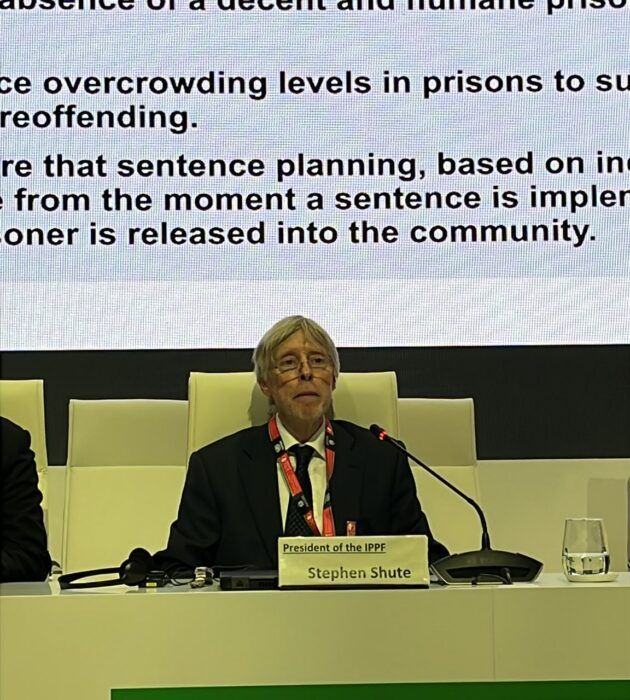
Professor Shute’s presentation, ‘Pushing the Frontiers of Reducing Reoffending’, built directly on the IPPF’s October 2025 International Colloquium in Tokyo, organised in partnership with the Japanese Ministry of Justice and the United Nations Asia and Far East Institute for the Prevention of Crime and the Treatment of Offenders (UNAFEI). It distilled the lessons of that work into a clear implementation agenda for governments, criminal justice institutions and communities.
A central message was that reducing reoffending cannot be achieved by the criminal justice system alone. The Kyoto Model Strategies place rehabilitation, social reintegration, individual desistance and restorative justice at the centre of reform, while recognising the need for flexible, individualised approaches that respond to different national contexts.
The IPPF identified three priority areas for implementation.
- First, rehabilitation and social integration in correctional facilities require humane prison conditions, reductions in overcrowding and properly resourced, individualised sentence planning from the beginning of a sentence through release.
- Second, rehabilitation in the community requires credible diversion, probation and other non-custodial measures that combine supervision with genuine support and reintegration.
- Third, sustained progress depends on partnership: criminal justice agencies, health and social welfare systems, civil society and communities must work together to support people after release and to create a culture in which second chances are possible.
The presentation drew on promising practice from a wide range of jurisdictions, including Ireland, Costa Rica, Tajikistan, Austria, New Zealand, Chile, Argentina, Colombia and Japan. These examples demonstrated that implementation is not a single model but a shared commitment to evidence, dignity, continuity of support and community engagement.
Looking ahead, the IPPF has committed to disseminating the Kyoto Model Strategies through its members, to continuing engagement with the United Nations Office on Drugs and Crime (UNODC), UNAFEI and other institutes of the United Nations Crime Prevention and Criminal Justice Programme Network, and to promoting rigorous periodic review of implementation in member countries.
The message from Abu Dhabi was therefore both practical and ambitious: reducing reoffending requires systems that are humane, evidence-informed and connected to the communities they serve — and the IPPF intends to play an active role in turning that ambition into policy and practice.
For the IPPF, the event also carried a wider significance. With roots extending back to 1872, and as the organisation from which the United Nations Crime Congress tradition developed, the Foundation is once again placing its distinctive international network and expertise at the centre of contemporary policy discussion. The Abu Dhabi meeting forms part of a broader programme of renewed engagement with the institutions shaping global criminal justice policy.