Our History

Our Purposes
The International Penal and Penitentiary Foundation (IPPF) is an international organisation with a history spanning over 150 years.
Our roots can be traced back to 1872, when the International Prison Commission (IPC) was established to collect national prison statistics and make recommendations for prison reform. When the League of Nations was formed in 1919, the IPC became affiliated with the League, and in 1929 the IPC was renamed the International Penal and Penitentiary Commission (IPPC).
Our strong foundations in international human rights bodies are further reflected in the fact that the IPPF’s originating statute was created by the United Nations. In 1948, the Economic and Social Council of the UN (ECOSOC) decided that the UN should assume responsibility for action in the field of crime prevention and the treatment of offenders. As a result, the IPPC was dissolved in 1951 and its functions were transferred to the UN.
In July 1951, the International Penal and Penitentiary Foundation (IPPF) was established as a Foundation under Swiss law. Its seat remains in Bern, Switzerland.
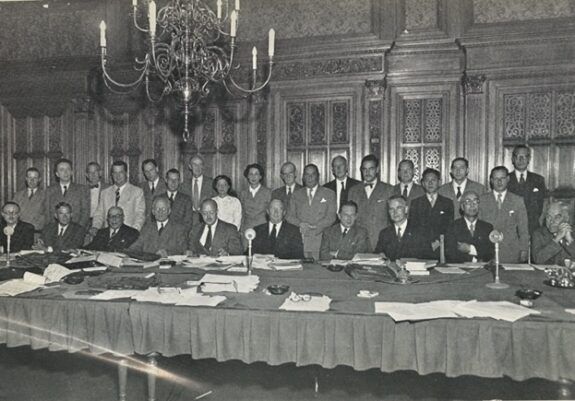
The IPPF is not a non-governmental organisation. Rather, under its founding statute adopted by the United Nations General Assembly, it is an sui generis or unique association. The IPC, IPPC, and later the IPPF have significant roles in the development of both the United Nations Standard Minimum Rules for the Treatment of Prisoners (the Nelson Mandela Rules), and the United Nations Standard Minimum Rules for Non-custodial Measures (the Tokyo Rules).
In fact, the IPC produced the first version of the Standard Minimum Rules for the Treatment of Prisoners, which was adopted by the League of Nations in 1934. The IPPC, and later the IPPF, revised and expanded these rules into the 1955 United Nations version, increasing the number of provisions from 55 to 78.
In 1988, the IPPF also contributed to the drafting of the United Nations Standard Minimum Rules on Non-Custodial Measures.
The IPPF has also contributed to the development of criminal justice policy worldwide. Since its creation, the IPPF has regularly organised colloquia addressing key issues and challenges in penal and penitentiary policy and administration, which have resulted in numerous publications. In recent years, these volumes have been complemented by country reports providing valuable insights into penal and penitentiary policies across the world.
IPPF’ colloquia have served as supportive forums for international exchange among academics, members of the judiciary, prison administrators, policymakers, non-governmental organisations, and other stakeholders involved in or affected by penal and penitentiary policy.
International Governance
In terms of governance, the IPPF benefit from the remaining assets of the former IPPC. This historical link with the IPPC is also reflected in the composition of the IPPF’s membership. Under its statutes- the most recent version of which dates from 2016- the Foundation is composed of three committees: the Principal Committee, the Associates Committee, and the Fellows Committee.
The Principal Committee is composed of individuals from each of the countries that were represented on the former IPPC. The twenty-five countries are: Argentina, Austria, Belgium, Chile, Denmark, Egypt, Finland, France, Germany, Hungary, Ireland, Italy, Japan, Luxembourg, Norway, The Netherlands, New Zealand, Poland, Portugal, South Africa, Spain, Sweden, Switzerland, the United Kingdom, and the United States of America. Each country may have up to three members on the Principal Committee, representing academia, the judiciary, and criminal justice or prison administration. This structure gives IPPF its unique composition and breadth of expertise.
Members of the Associates Committee may come from any other country or from public or private international organisations working in our field.
The Fellows Committee is comprised of individuals who have previously served on either the Principal Committee or the Associates Committee.